For this week’s blog, let’s think about Postmodernism for a bit. Your task will be to find a piece of postmodern media/art on the internet, share it on your post, and then offer your explanation of why it is Postmodern. You may analyze an advertisement, a film, a TV show, a music video, a painting, a building, a sculpture, a book, a short story, a poem, etc. It’s important that you share in some way your POMO media on your post so we can see it, and comment on it. To help guide you, look for art/media that is self-referential, that knows it is an illusion, or challenges the viewer’s suspension of disbelief. Look for work that questions some of our “fundamental” truths. Look for the incomprehensible or absurd. Have fun. Be POMO!
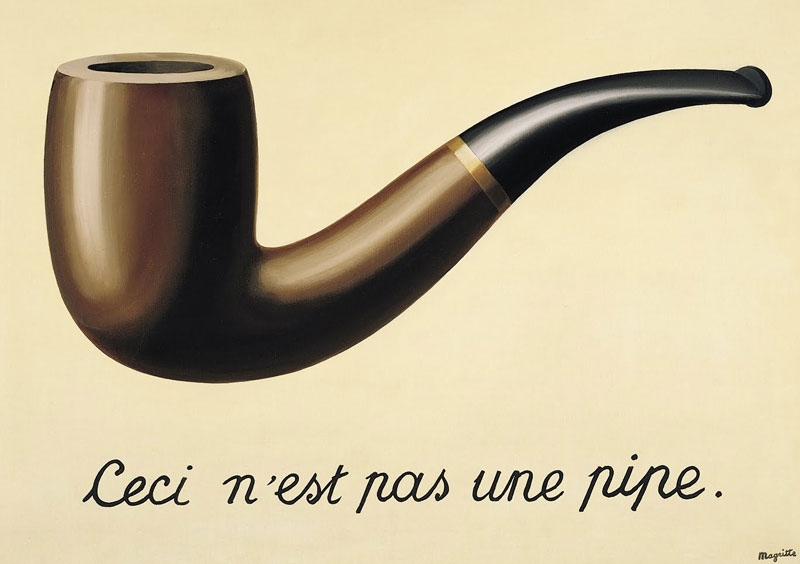
P.S. Here’s a famous example of Postmodern art by Rene Magritte. (The text says, “This is not a pipe.”) Think about it...

P.S. Here’s a famous example of Postmodern art by Rene Magritte. (The text says, “This is not a pipe.”) Think about it...

This comment has been removed by the author.
ReplyDeleteAccording to the reading, postmodernism rejects the values of the past… not to support new values but instead to ironize them…. they tend to produce ironic or parodic twist. Therefore, the postmodern piece that I came up with is the film "deadpool". We all know that deadpool is a not a typical marvel's super hero. Usually, people are familiar with "outlaw" hero or "official", which are a two group that still follow certain moral standards and seek to contribute something positive to the society as a whole. However, deadpool is also a hero, but he's more of an antagonist who is selfish and nihilistic. He doesn't think twice about destroying, killing, and hurting innocent people or take down skyscrapers if they are in his way, when he is onto something. In fact, this scene below, he's celebrating the fact that he's trapping a person in the trunk and ordering the taxi's driver to kill him. Deadpool cusses like a sail in almost every line. He's also into porn, revenge, and sarcasm. His character is unlike the ethical, honest, and selfless heroes in the past like superman, batman, mulan, and official heroes. In the reading, batman is not at all willing to kill the joker even though he had the perfect chance. That's what makes heroes so loved and treasured because they're so affectionate and tender. However, Deadpool at the last scene when asked to reflect on his action before killing the enemy, he kicked his comrade out of his way, and finished his enemy off. That is why Dead pool's character is ironic because he is different from any type of hero we've seen before. Underneath Batman, Spiderman, and Superman's mask, there's a bright, handsome face. However, Deadpool is hideous. This emphasizes postmodernism because filmmakers are reversing all of the stereotypes and old values in the past and even poke fun at them by introducing this new character.
ReplyDeletehttps://www.youtube.com/watch?v=eC8UbmU2kB8
Very well-said. I feel like postmodern ideas and reversed tropes in movies is a big risk in Hollywood, and Deadpool illustrates that. Fox didn't even think people would want to pay to see an R-Rated, swearing superhero on the big screen until the test footage was leaked to great acclaim. It goes to show that big risks can sometimes yield the biggest rewards.
DeletePostmodernism is a trend or movement in the arts and literature that developed in the 1970s in reaction/rejection of principles or practices of established modernism. It has overturned the ideas that there is one inherent meaning to a piece of art or the artist didn’t determine the meaning at the time of its creation.
ReplyDeleteI came across the artist Banksy, who is very famous on the graffiti scene (also has done some film production). Since the early 1990s, his artwork has shown up in places throughout England, America and even Israel. Many pieces of his artwork contain irony and parody that are geared toward social issues and the government by displaying concepts of the law, religion and governmental policies. He has some retro techniques where he takes something that already exists and recycles it into something new. His work tends to be very controversial to some, but he brings light to many topics in all of his paintings.
It is hard to pick a favorite art piece by him, but if I had to narrow it down to one, my favorite one would be the Crayola Shooter that he painted back in 2011. He drew a young boy with a gun the size of him and crayon coloring around him. His goal is to show the dark reality of child soldiers in our war torn world. It is believed that with the use of the color around the boy who is drawn in black and white is to show the loss of childhood in the picture.
here is the link to the picture, but also more work by Bansky:
http://uk.complex.com/style/2013/11/banksy-greatest-works/crayola-shooter
I've always been fascinated with artists but have never heard of Bansky! And that I agree with you that the picture depicts a loss of childhood. The young boy cringe as he is holding the gun because he is taking on a big role, not typically something a kid would do. War seems to leave an emotional impact for the boy and rest of the kids, to being dealing and witnessing such trauma and sufferings. This post modernism art piece really highlights that theme.
DeleteI really liked the Dorothy Police Search, Pre-2009 picture. I thought that it was very ironic and unique compared to other pictures. I also thought that this picture related past and present times.
ReplyDeletePostmodernism is a wide-reaching idea that is able to be portrayed through many different media. While the practice is probably most well-known in art and paintings, postmodernism can also be found in television, movies, literature, and even in advertisements. I felt that it would be interesting to analyse some piece of postmodern advertising for the purposes of this blog post. While googling for possible candidates, I stumbled upon an online article from "The Beak Street Bugle" journalist Alex Reeves discussing how one company is working to expose clever and postmodern advertising to the world for a good cause. The company in question, called Advertising Community Together (ACT Responsible), helps other independent advertisers that want to get involved with eco-friendly or philantropic organizations with their advertising campaigns. ACT's job is a tricky one, as any ad they make has to conform to the preestablished ideals of the NGO (non-governmental organization) itself while still being able to connect with the good cause and with their target audience. The results are pretty clever and thought-provoking ads that send important messages. For example, one of the ads featured in the article was put out by hungrychildren.com and shows a picture of a thin, frowning dark-skinned boy crouching and tugging at the tattered dress of a woman. The only text is the famous phrase, "Got Milk?" in it's familiar white font. This advertisement portrays a sort of dark, twisted but clever sense of humor. The "Got Milk?" slogan is normally associated with celebrity endorsements and the "glamour" of drinking milk. But in this context, the slogan is almost poking fun at the fact that this obviously malnourished boy in some third-world country is hungry. This displacement of expectations is sure to catch a person's attention and get them thinking. Its worth reading the article and checking out the other ads too:
ReplyDeletehttp://beakstreetbugle.com/articles/view/248/advertising-for-goodness-sake-charity-ngo-advertising-act-responsible
Very intriguing to see Postmodernism in advertising. This image is haunting because it turns a harmless slogan into an indictment. Great post!
Delete